FoRB Roundtable’s online meeting with ODIHR on 11 December
View this email in your browser Second Call: RSVP for our online meeting with ODIHR on 11 December Dear participant to the…
8 décembre 2024
A rapid history of FECRIS
The European Federation of Centres for Research and Information on Sects and Cults (FECRIS) is a French-registered umbrella organization that gathers anti-cult associations all over Europe and beyond. It was created on June 30, 1994, by the French anti-cult association UNADFI (National Union of Associations in Defense of the Individual and Families against Cults), and registered at the very same address as UNADFI. It was created with the aim of coordinating the anti-cult movement at European level.
It started with a representation in 10 different countries, and rapidly grew to attain 36 member organizations in 24 different countries in 2001.
In 2009, FECRIS was granted « ECOSOC Special Consultative Status » by the United Nations.
In several countries, FECRIS member associations have been created by, or merged with, or have close links to State religions that uses them as a way to eliminate what they see as competitors. As said in Freedom of Religion or Belief Anti-Sect Movements and State Neutrality A Case Study: FECRIS, a collective academic book published by Lit Verlag, “FECRIS gathers associations with various, even contradictory, vested interests which see an opportunity to ally to fight against religious minorities.” The book gives examples: “France, the cradle of laïcité [French secularism] and the driving force of the anti-sect fight in Europe promoting the separation between State and religion; Austria and Germany, where public powers and dominant churches lead a common struggle against “sects”; and Serbia and Russia, two Orthodox countries in which FECRIS member associations include Orthodox missionary departments instrumentalizing the sect issue to eliminate competitors of Orthodox Churches.” (The book)
FECRIS in Russia
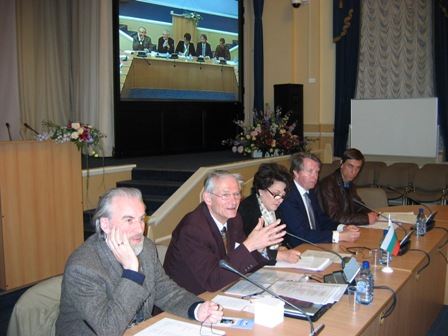
The main representative of FECRIS in Russia is Russian Orthodox Theologian Alexander Dvorkin. In 1993, he founded the Saint Irenaeus of Lyons Information and Advisory Center, which is the chief organization of the RATSIR (Russian Association of Centers for the Study of Religions and Sects), itself an umbrella organization that gathers a great number of anti-cult associations, almost all linked with the Russian Orthodox Church (ROC), and often merged with it. The Center itself was blessed by Patriarch Alexy II, who, in March 2002, in a low-key ceremony, consecrated a church at the Lubianka headquarters of the Federal Security Bureau, which is the successor to the KGB, with a “ceremony focused on the need for concerted actions aimed at combating the current threats posed to Russia’s ‘spiritual security,’” as the Patriarch said.
Dvorkin’s organization joined FECRIS and changed its name into Saint Irenaeus of Lyons Center for Religious Studies in 2003.
The Vice President of RATSIRS is Archpriest Alexander Novopashin and its Executive Secretary is Priest Alexander Kuzmin.
Novopashin is the rector of the St. Alexander Nevsky cathedral, in Novosibirsk, and head of the Information and Advisory Center on Sectarianism, a FECRIS member association which is located in the cathedral and whose assistants and ordinary employees are the priests of the cathedral. (Source)
Kuzmin, besides being a priest of the Russian Orthodox Church is the head of the Saratov branch of the Center for Religious Studies, a member association of RATSIR, located in Saratov.
As stated in the already quoted book Freedom of Religion or Belief Anti-Sect Movements and State Neutrality A Case Study: FECRIS, in Russia the “concept of spiritual security has been used by Russian ideologues of the right and left”, and “Spiritual security, then, serves as the basis for a campaign based on paranoia of “foreign” enemies and “foreign” ideas, and for measures to unduly restrict freedom of religion or belief of Russian citizens who have decided to follow a non-consensual spiritual path. Members of the European Federation of Centres of Research and Information on Sectarianism (FECRIS) in Russia play prominent roles in this campaign and repressive policy.”
Fostering the crackdown on religious minorities in Russia
As stated in the 2020 report for the US Commission on International Religious Freedom (USCIRF) called The Anti-cult Movement and Religious Regulation in Russia and the Former Soviet Union, FECRIS “regularly spreads negative propaganda about religious minorities, including at international forums like the annual Organization for Security and Cooperation in Europe (OSCE) Human Dimensions conference. Dvorkin’s SILIC (Saint Irenaeus of Leon Information-Consultation Center) is the primary associate of FECRIS in Russia and receives significant financial support from both the ROC and the Russian government.” (The report)
The Russian members of FECRIS have been campaigning in Russia against movements they decide to label “destructive cults”. The list of targeted movements is quite long, but includes all movements that are seen as “foreign” and “non-traditional” religions: the Baptists, the Pentecostals, Jehovah Witnesses, Hindus, almost all Muslim groups that were not part of the officially recognized branch which is approved by the FSB, Scientologists, the Falun Dafa, the Church of the Latter Days Saints, etc.
While the troubles for these religious or spiritual movements started in the late 90s, it should be noted that the real crackdown and the stiffening of the repression started after 2009. As mentioned in the USCIRF aforementioned report: “Dvorkin’s official influence increased significantly in the late-2000s. In 2009, he was appointed head of the Russian government’s Council of Experts, tasked with monitoring religious activity and approving legal registration. The Council was created in 1998 to help enforce the 1997 law. The amended law of February 18, 2009 expanded the Council’s reach, giving it authority over the activity, structure, and religious content of registered organizations alongside its oversight of the registration process.”
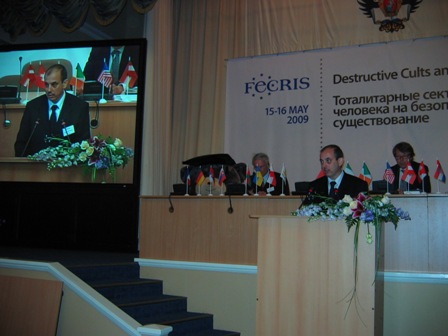
It was exactly during this same time FECRIS held its annual international meeting in Saint-Petersburg. During the meeting (15-16 May 2009), the executives of FECRIS from all over Europe had private meetings with Russian Federation officials, including with Alexandr Konovalov, the Russian Minister of Justice (from 2008 to 2020) who was called “the hidden monk” for his allegiance to the ROC. They also met Judge of the Constitutional Court of the Russian Federation, S. M. Kazantsev.
This was confirmed by Alexander Dvorkin himself, who wrote in a press release on behalf of his organization: “During the conference, the Minister of Justice of the Russian Federation A.V. Konovalov met with the leadership of FECRIS and the Rector of St. Petersburg State University N.M. Kropachev, which took place in the office of the latter. A similar meeting was also held in the Constitutional Court of the Russian Federation, where a group of conference participants was received by Judge of the Constitutional Court of the Russian Federation S. M. Kazantsev. During these meetings, the parties exchanged information and discussed ways to prevent the negative consequences of the activities of totalitarian sects.” (Source) Novopashin also wrote on his website: “In addition to Alexander Dvorkin and prominent officials, our country was represented at the conference by Alexander Konovalov himself, who arrived on the second day of the event and held an hour-long meeting with the FECRIS management.” (Source)
In what may be seen as a favor returned to the Russian authorities, that very same day Dvorkin was elected as vice-president of the FECRIS.
Since that date, things have escalated for religious minorities in Russia, culminating with the ban of the Jehovah Witnesses in Russia, declared by the Supreme Court as an “extremist group” which led to dozens, if not hundreds of jail terms for peaceful members since 2017. Not only the Jehovah Witnesses but many other movements had to face discriminatory measures and persecution against their members, due to the growing restrictions on freedom of religion or belief in the country, and the fierce repression in which the authorities have engaged over the last decade.
Fueling anti West propaganda around the conflict with Ukraine
The anti-west propaganda in Russia is certainly not a new topic, nor a FECRIS exception. Nevertheless, FECRIS definitely plays its part. The anti-West propaganda is based on the idea that foreign religions are influencing Russian society from inside, and therefore are against patriotic ideals. As stated in USCIRF 2020 report: “Echoing Putin’s concerns about spiritual and moral security, Dvorkin claimed in 2007 that NRMs deliberately “inflict damage on Russian patriotic feelings.” In 2010, he gave a lecture entitled “Totalitarian Sects as a Threat to National Security” to students at the Institute of the Federal Security Bureau (FSB)—the main successor to the Soviet-era KGB. In 2012, Putin claimed that “totalitarian sects” were “growing like mushrooms,” and “present[ed] a distinct threat to society” that needed to be addressed by legal mechanisms at both the local and federal levels.”
Then, according to the same report, after Russia invaded Crimea: “Russia brought along its restrictive religious regulation framework when it invaded Crimea in 2014, including the symbiosis between anti-cult ideas and national security. The occupation regime in Ukraine frequently has used religious regulations to terrorize the general population”.
In the Ukrainian pseudo-states Donetsk and Lugansk, controlled by pro-Russian separatists, just after the war started in 2014, a new “constitution” was proclaimed. It’s the only constitution in the world that makes “fighting cults” a constitutional principle. In Donetsk and Lugansk nowadays, the only authorized religion is the Russian Orthodox Church. Alexander Dvorkin is not a stranger in this, to the point that in 2014, Dvorkin had been invited by the Archbishop of Lugansk and Alchevsk Mitrofan (Ukrainian Orthodox Church/ Moscow Patriarchate) to give some lectures about “cults” on 9-10 April in Lugansk, and was denied entry in Ukraine at the airport of Donetsk and sent back to Russia. (Source)
While the official reason justifying his deportation was that he had been seen with the wife of Gubarev, the self-proclaimed governor of Donetsk, it might also have to do with the numerous statements Dvorkin made in early 2014 about the “Maidan regime”, accusing elected politicians to be forwarding a Western agenda, and to belong to “dangerous cults”, as Greek Catholics, Baptists, Scientologists, Pentecostals, and even advancing the idea that the Pope Francis had adopted a pro-revolutionary Marxist attitude in support of the Maidan protests. (Source)
These statements received extensive press coverage in Russia, and rapidly became part of the official storytelling on Ukraine in the Federation. In addition to this, Dvorkin, on behalf of FECRIS, accused the “neo-pagans” who were now in the government, to be neo-Nazis, a rhetoric that has continued until these very days whilst the war is ongoing, and are used by the Putin’s propaganda machine to justify the war in Ukraine. (Source)
Supporting the war against Ukraine
FECRIS’ contribution to Russian propaganda against Ukraine continued until the war began, on February 24, 2022, when Putin’s armed force started to invade and bomb Ukraine.
Did it stop then? Not at all. In fact, all FECRIS groups in Russia have supported the war efforts and official Russian propaganda justifying the war. Echoes to the “Spiritual war against the Gay pride” (see here) as promoted by ROC Patriarch Kirill can be found on all Russian FECRIS websites. Here are a few examples:
On the FECRIS group Saint Irenaeus of Lyons Center for Religious Studies’ website, on 20 March 2022, an interview of Roman Sylantev, a close colleague of Dvorkin in the fight against “cults”, was posted. In this interview, Sylantev praises the war, supporting the concept that “joint military operations” are the best vehicle to “strengthen friendship between people of different nations and faiths to the maximum”, and that because of war, “tension in the interreligious and interethnic spheres has significantly decreased in Russia”. For Sylantev, the war is also good because now “large commercial cults are leaving Russia”. (Source)
On Archpriest Alexander Novopashin’s website, which is at the same time the website of the Alexander Nevsky’s Cathedral in Novosibirsk and the one of the FECRIS group Information and Advisory Center on Sectarianism, you can find several interviews and articles published since the beginning of the war. One of them is dedicated to the position of Novopashin himself. Indeed, according to the article, “some forces maliciously distorted the meaning of his public statements” about “the events in Ukraine”. These forces, says the article, led people to believe that he “was really calling people to the streets to oppose the government”. Not at all, says Novopashin. This was “provocation” and lies. “I have a clear and convinced attitude towards Nazism as to Satanism”, he says, echoing the propaganda about “denazification” of Ukraine by the Russian army. “The ideology of Nazism must be destroyed – it is anti-human and has a satanic origin. Therefore, my attitude to the fight against Nazism is unequivocal … I will never call anyone to the streets to defend evil.” Then, finally: “Any disease must be cured, and, alas, if a person has gangrene, you have to take away their hand, resort to surgical methods.” (Source)
Another article on the website is an op-ed by a man called Serguey Komarov, who is presented as being of Ukrainian origin and has an interesting point of view on war. For him: “God allowed war to come” because it’s God’s punishment against Ukrainians. “And now this horror will have to go through not only Donbass, but the whole of Ukraine. When God’s punishments come, they concern everyone – both the guilty and the innocent, both the bad and the good”, says Komarov. Then, adapting a biblical reference: “It doesn’t matter who is an instrument in the hands of God. It is important that the Lord punished Israel for their iniquity by the invasion of different peoples and is able in our time to teach and punish peoples and countries in the same way. Biblical laws are eternal. Fascism is evil and will be punished by God. Fascism cannot be dealt with. It can only be destroyed. It’s time for someone to pay the bills. Russia was left with no choice.” (Source)
Another article on Novopashin’s website is op-ed by Protodeacon Vladimir Vasilik. Vasilik makes clear that we should not worry about war against Ukraine, “because in reality there is no Ukrainian statehood. There is, on the one hand, a gang of thieves and international speculators, and on the other hand, a gang of fanatics and murderers who speculate on the blood of the Ukrainian people.” For him, the Russian army is only furthering a mission of peacekeeping: “We will also pray for the Ukrainian servicemen to lay down their arms as soon as possible and, in cooperation with the Russian troops, establish peace… And may God help to grant peace in Ukraine as soon as possible through the hands of Russian peacekeepers, for which we all pray.” (Source)
Acting with Russian law enforcement agencies to hunt peace advocate dissidents
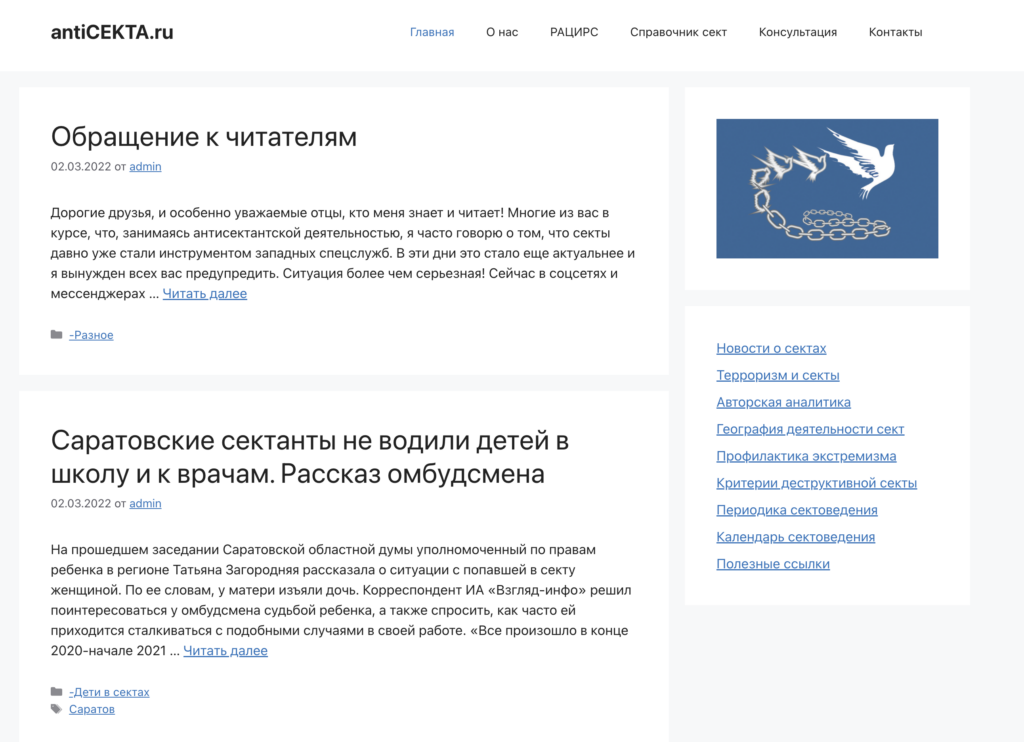
On the website antisecta.ru, belonging to the Centre of Religious Studies – Saratov, a FECRIS group headed by Alexander Kuzmin, Executive Secretary of RATSIR, we can find a very interesting call to denounce those who would forward ideas of “peace” against “war” in Ukraine. After having made clear that “the West” was behind an “information war” intended to “undermine human behavioral stability” by pretending that the Russian army would “bomb civilians” in Ukraine, or that there would be “dead conscripts” from the Russian army on the battlefield, Kuzmin launches a call of denunciation: “Please also help in monitoring the activities of such provocateurs. Please send screen shots, their designated data (names and surnames, phone numbers and e-mail addresses) for further analysis, which is conducted by our anti-sectarian organizations together with the law enforcement agencies of the Russian Federation.” (Source)
It’s not the first time that FECRIS groups work hand in hand with law enforcement agencies, including the FSB and other secret services in order to denounce dissidents, but nowadays, with the ongoing war and the new law in Russia which penalizes anyone to be jailed for up to 15 years for “discrediting the armed forces” and/or pronouncing the word “war” instead of “special military operation”, this activity takes on its full significance.
Anti-West propaganda as a general pattern
The anti-West propaganda of FECRIS is not limited to nowadays, and not limited to Russia. Looking for support from countries that might see the “West” and especially the US with a quite negative view, FECRIS has relied on a narrative that is fueling a strong negative attitude toward democratic western values, a narrative made of a not unusual conspiracy theory – Western secret services use the “cults” to forward their agendas – capitalizing on a pre-existing or newly created anti-western sentiment.
Examples are legion, but let’s focus on a few of them. In 2009, during the annual meeting of FECRIS in Saint Petersburg, a speech was given by Belarusian FECRIS participant Vladimir A. Martinovich, about the political influence of “cults”. He started by identifying what he called the difference between “the simple desire to build up favorable opinion” and “the long term major ideological actions of the cults” going on to explain that in Belarus, with regards to the latter, “the largest action of this kind was organized by Pentecostals, Baptists and other Christian cults.” (Source)
Then he develops his theory by expressing the idea that the US have been focusing on International Religious Freedom, not to defend this freedom at all, but to gain political influence: “the ‘International Religious Freedom Act’, adopted in 1998 by the American congress, and the annual publications of the US Department of State about religious freedom in various countries of the world have influence on the politicisation of the cultist/sectarian problems on an international level. The human rights and religious organizations of the whole world collect material about real and invented cases of suppression of religious minorities for the preparation of the publication of the US Department of State. There are some reasons to doubt that the fate of those minorities is of real interest for the authors of that publication. (…) In agreement with the results of research, the conclusion can be drawn that violations of rights of religious minorities may be used as an occasion for political pressure by one country on another.”
Another FECRIS speaker that very same day was German Pastor Thomas Gandow, cult counsellor of the Protestant church of Berlin-Brandenburg, and head of a German counter-cult group. He called his presentation “Cults or foreign lobbying groups?” and echoed Martinovich briefing, saying that “in the USA a whole series of governmental commissions are busy enforcing the US concept of ‘religious freedom’ and the lobbying activity for US organizations in the world.” That in itself, adds Gandow, justifies the need for FECRIS to engage in political activities (while in its bylaws, FECRIS affirms that it never does so): “Because the lobbying against cults towards politicians, authorities, scientists and even sometimes churches may be successful, it is important that FECRIS and its associations participate in the political opinion forming of our societies.” (Source)
So when Dvorkin, in May 2020, took the floor at the most important Russian Orthodox gathering of the year, the XXIX International Educational Readings, organized by the “Missionary Service of the Russian Orthodox Church” and under the patronage of Patriarch Kirill, he does not feel unsupported when he attacks the West for its “anti-Orthodoxy agenda”: “As for the actions directed specifically against Russia, this is where a very important event took place over the past year: on February 5, 2020, the United States Department of State officially announced the creation of the « International Religious Freedom Alliance ». (…) This is an organization that, apparently, is largely directed against Orthodoxy in general and against Russia in particular. (…) Among the countries that have joined this alliance, if alphabetically, the first is Albania, the last is Ukraine. There are very few Western European countries on the list: first of all, these are the countries of the former Soviet Union, the former socialist camp, and, well, Greece, which obviously had its arms twisted and was forced to join, all these countries make up two-thirds of the members of this alliance. It is quite obvious that this is to create a ‘cordon sanitaire’ around our borders and, of course, it is an instrument of pressure on Russia, and an instrument of pressure on Orthodoxy.” (Source) For Dvorkin, the International Religious Freedom Alliance was made to attack the Orthodox world, and the presence of Ukraine was not a coincidence.
Support of Russian FECRIS and complicity by FECRIS
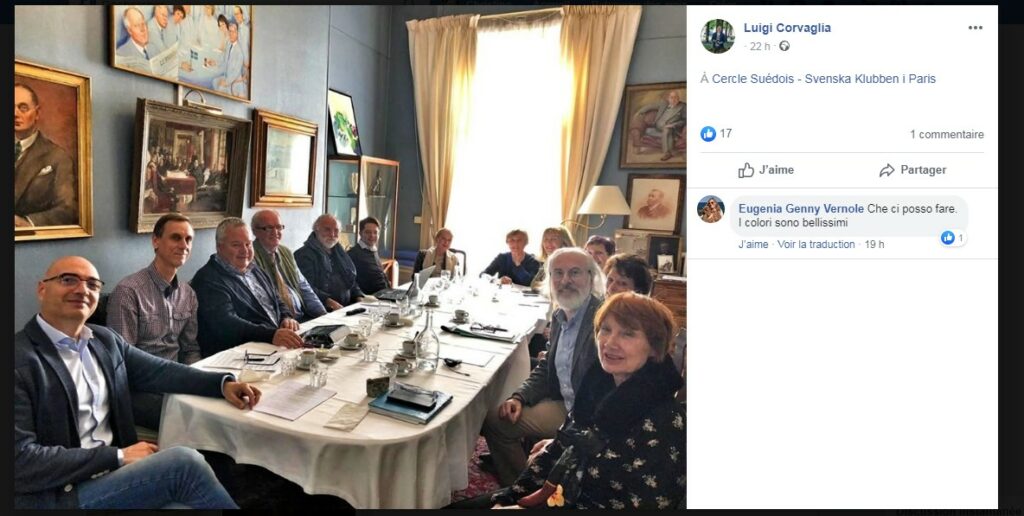
In 2009, during the annual meeting of FECRIS in Saint-Petersburg, Dvorkin expressed gratitude to FECRIS for having endorsed and registered his association: “In my country alone we have about thirty active and functioning cult research and information centers. We highly appreciate that document which gave much impetus to our young and not so much experienced organizations to work and to move forward. We felt that we are not alone and that the most sincere, responsible, honest, and wise people in Europe support our work and offer us to work together.” (Source) A few days later, answering to the Russian National News Agency, he added: « I regard this as a high level of trust, not only in me, but also in my Russian colleagues. The participation of a Russian representative in the leadership of an organization that is an official consultant to the Council of Europe raises the status of our country. » (Source)
That support in itself, which has continued until today, is enough to conclude that FECRIS has been contributing to the outrageous actions of its Russian members. Throughout these years, FECRIS has been warned and alerted about the anti-Western propaganda of its Russian members, as well as about the fierce oppression that they were orchestrating against minority religions in post-soviet states. They did nothing. In 2012, a book was written which included a full chapter on Russian FECRIS and its links with the extremists of the Russian Orthodox Church and the power in place. FECRIS did nothing about it, and continued its support. Since 2014, numerous articles have been written to denounce the role of Dvorkin in participating to the Kremlin’s propaganda against the West, Ukraine, and religious minorities. FECRIS did nothing about it.
More than that, they reelected Dvorkin as a Vice-President in 2018, showing their full support of his actions. To this very date, one month after the Russian invasion of Ukraine started, and after thousands of civilians have lost their lives, Dvorkin has not been removed from the FECRIS board of directors nor his actions condemned, and the Russian FECRIS associations that appear in this very article are still listed as genuine FECRIS members and correspondents on the FECRIS website.
A few days after an article was published in the European Times, called “How the anti-cult movement has participated to fuel Russian anti-Ukraine rhetoric”, which mentioned FECRIS as being behind Dvorkin’s participation to the Kremlin’s propaganda, FECRIS felt compelled to publish on their website a timid statement “to join in the condemnation of the Russian military aggression against the Ukrainian population and legitimate authorities”. This is nothing less than a pathetic attempt to absolve itself of its own responsibility.
View this email in your browser Second Call: RSVP for our online meeting with ODIHR on 11 December Dear participant to the…
8 décembre 2024contact@forbroundtable.org https://www.forbroundtable.org December 17, 2023 To: All French Deputies All French Senators Re: The current French bill on “Reinforcing the Fight…
18 décembre 2023FRANCE: BILL “TO REINFORCE THE FIGHT AGAINST CULTIC DEVIANCES” A REAL THREAT TO FREEDOM OF CONSCIENCE, RELIGION AND BELIEF Executive Summary The…
27 novembre 2023